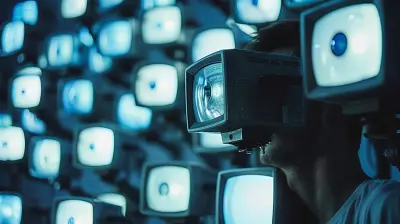
Exploring the Future of Distance Education in 2027
5 May 2026
Let me paint you a picture. It's 2027. You wake up, grab your coffee, and sit down at your desk. No commute, no rigid schedule, no boring lectures. Instead, your screen lights up with a holographic professor who knows your name, your learning style, and exactly where you got stuck last night at 2 AM. Sounds like science fiction, right? But the truth is, distance education in 2027 isn't just about watching videos on a laptop anymore. It's a full-blown revolution, and we're all sitting in the front row.
I've been watching this space for years, and I'll tell you straight: the future of online learning is not what you think. It's wilder, more personal, and honestly, a little bit intimidating. But that's okay. Let's break it down together.

Why 2027 Is the Make-or-Break Year for Online Learning
Here's the thing. We've been talking about "the future of education" for decades. Remember the hype around MOOCs in 2012? Everyone thought they'd kill traditional colleges. That didn't happen. Then came the pandemic in 2020, and suddenly everyone was a Zoom teacher. That wasn't great either. But 2027? That's when the pieces finally click into place.Why? Because technology has caught up to the promises. By 2027, the internet is faster, cheaper, and more accessible than ever. 5G is old news, and 6G is rolling out in major cities. Artificial intelligence isn't a buzzword anymore -- it's a silent partner in every classroom, virtual or not. And students? They're done with passive learning. They want to touch, feel, and interact with their education. They want it to bend to their lives, not the other way around.
So, what does that actually look like? Let's dig in.

From Passive Videos to Immersive Realities
Remember those old online courses where you'd watch a grainy video of a professor talking to a whiteboard? Yikes. In 2027, that's about as relevant as a flip phone. The new star of the show is immersive reality -- and I'm not just talking about VR headsets.Imagine studying biology by walking inside a human heart. You see the chambers, the valves, the blood flowing. You can reach out and "touch" a clogged artery. That's not a field trip -- that's your Tuesday afternoon anatomy class. Or picture a history lesson where you stand in ancient Rome, watching the Colosseum being built brick by brick around you. You smell the dust, hear the chatter of the crowd. This is distance education in 2027.
And here's the kicker: you don't even need fancy equipment. By 2027, most of this works on your phone or a lightweight pair of glasses. The technology is cheap, fast, and intuitive. It's not about escaping reality -- it's about enhancing it. We're talking about augmented reality (AR) overlays that turn your kitchen table into a chemistry lab or your living room into a courtroom for mock trials.
Does this sound expensive? Not anymore. The cost of these tools has dropped dramatically. Universities are investing in shared platforms, and many offer free AR kits to enrolled students. The result? Learning feels less like work and more like exploration.

AI Tutors That Actually Get You
Let's be honest. One of the biggest problems with traditional online learning was the loneliness. You'd watch a video, take a quiz, and... that's it. No one to ask for help at 3 AM. No one to push you when you're slacking. But 2027 changes all that with AI tutors that are genuinely helpful.I'm not talking about clunky chatbots that give canned answers. I'm talking about AI that knows you. It remembers that you learn better with diagrams than text. It notices you get anxious before math exams and offers calming exercises. It tracks your attention span and breaks lessons into chunks that match your rhythm. It even adjusts its tone -- serious when you need focus, playful when you're stuck.
Here's a real scenario. You're studying calculus. You've been staring at derivatives for an hour, and nothing is clicking. Your AI tutor steps in. "Hey, I see you're struggling. Let's try a different approach. Imagine you're driving a car, and the speedometer is the derivative of distance." Suddenly, the concept clicks. The AI doesn't just give answers -- it teaches you how to think.
And the best part? It's available 24/7, never judges you, and remembers every single interaction. It's like having a personal tutor who charges nothing and never gets tired. In 2027, no student ever has to feel stupid or alone again.

The Death of the One-Size-Fits-All Degree
Let's talk about the elephant in the room: the traditional degree. For decades, we've treated education like a factory assembly line. You take these courses, earn these credits, get this piece of paper. But in 2027, that model is crumbling.Why? Because the world has changed. Jobs don't look like they did in 1990. Skills expire faster than ever. A four-year degree is often outdated by the time you graduate. So distance education in 2027 is pivoting hard toward micro-credentials, stackable certificates, and lifelong learning.
Think of it like this: instead of buying a whole pizza (the degree) when you only want two slices (specific skills), you can now order exactly what you need. Want to learn blockchain for your finance job? There's a three-week course from a top university. Need to understand neural networks for a promotion? There's a weekend workshop with hands-on projects. These credentials are recognized by employers, stack together to form something bigger, and never expire because you can always update them.
The result? Education becomes modular. You build your own path. No more sitting through irrelevant classes just to check a box. You learn what you need, when you need it, and you prove your skills with real-world projects, not multiple-choice tests.
The Rise of Peer-to-Peer Learning Networks
Here's something surprising. Despite all the fancy tech, the most powerful force in distance education in 2027 is still human connection. But it's not the kind of connection you're used to.Forget discussion boards where you post a comment and wait three days for a reply. In 2027, learning happens in real-time, global communities. You might be in a study group with people from Brazil, Japan, and Kenya, all working on the same project. You use collaborative tools that let you code together, draw together, and even simulate experiments together. The distance isn't a barrier -- it's an asset.
These networks are self-organizing. AI helps match you with peers who complement your strengths and weaknesses. If you're great at writing but struggle with data analysis, you'll be paired with someone who's the opposite. You teach each other. You challenge each other. You hold each other accountable.
And here's the kicker: these networks often outlast the course. Students form lasting professional relationships, start businesses together, and build careers across borders. The classroom becomes a springboard for a global network, not a four-year silo.
The Teacher's Role Gets an Upgrade
I know what you're thinking. With all this AI and automation, what happens to the human teacher? Do they become obsolete? Not even close. In fact, 2027 makes teachers more valuable than ever, but their role shifts dramatically.Instead of being content delivery machines (which AI can do better), teachers become mentors, facilitators, and coaches. They focus on the things machines can't do: inspire curiosity, navigate ethical dilemmas, foster creativity, and build emotional resilience. A teacher in 2027 doesn't just teach you calculus -- they help you see why calculus matters in the context of your life and your dreams.
Picture this: your professor doesn't spend hours grading papers. AI handles that instantly. Instead, they spend that time in one-on-one video calls with you, discussing your progress, your struggles, and your goals. They become your guide through the chaos of information. They help you connect dots across disciplines. They challenge you to think critically about the world.
In short, technology handles the mechanics. Teachers handle the humanity. And that's a beautiful thing.
Challenges That Still Loom
Now, I won't pretend 2027 is a utopia. There are real problems we haven't solved yet. The digital divide is still real. Not everyone has a fast internet connection or a quiet place to study. Not everyone can afford the latest AR glasses or a powerful laptop. And while costs are dropping, equity remains a stubborn issue.There's also the question of motivation. Distance education requires discipline. Without the structure of a physical classroom, some students flounder. AI tutors help, but they can't replace internal drive. We're still figuring out how to keep students engaged when life gets in the way.
And let's not ignore the privacy concerns. AI tutors that know everything about you? That's a lot of data. Who owns it? How is it protected? What happens if it's hacked? These are questions that universities and policymakers are wrestling with, and the answers aren't always clear.
But here's the thing: every revolution has growing pains. The key is to acknowledge them, address them, and keep moving forward.
What This Means for You
So, where does this leave you? Whether you're a student, a parent, a teacher, or just someone curious about learning, 2027 is a year of opportunity. The barriers that once held back distance education -- cost, quality, isolation -- are falling. What's rising is a system that's more flexible, more personal, and more connected than anything we've seen before.You don't have to wait for the future to arrive. It's already knocking. Start exploring micro-credentials in your field. Try an AR learning app. Join a global study group. The tools are here, and they're only getting better.
The bottom line? Distance education in 2027 isn't a backup plan. It's not a compromise. It's the new standard. And if you're willing to embrace it, you'll find a world of learning that fits you, not the other way around.
Are you ready?
all images in this post were generated using AI tools
Category:
Distance EducationAuthor:

Madeleine Newton
Discussion
rate this article
2 comments
Valerie Navarro
In 2027, distance education will be a game changer, but let's hope it's not all Zoom fatigue!
June 4, 2026 at 11:25 AM
Madeleine Newton
I agree! Balancing technology and engagement will be key to keeping distance education fresh and effective.
Jamie Beck
This article offers great insights into the evolving landscape of distance education. Exciting changes are ahead!
May 7, 2026 at 4:51 AM
Madeleine Newton
Thank you for your feedback! I'm glad you found the insights valuable. Exciting times are indeed ahead for distance education.